
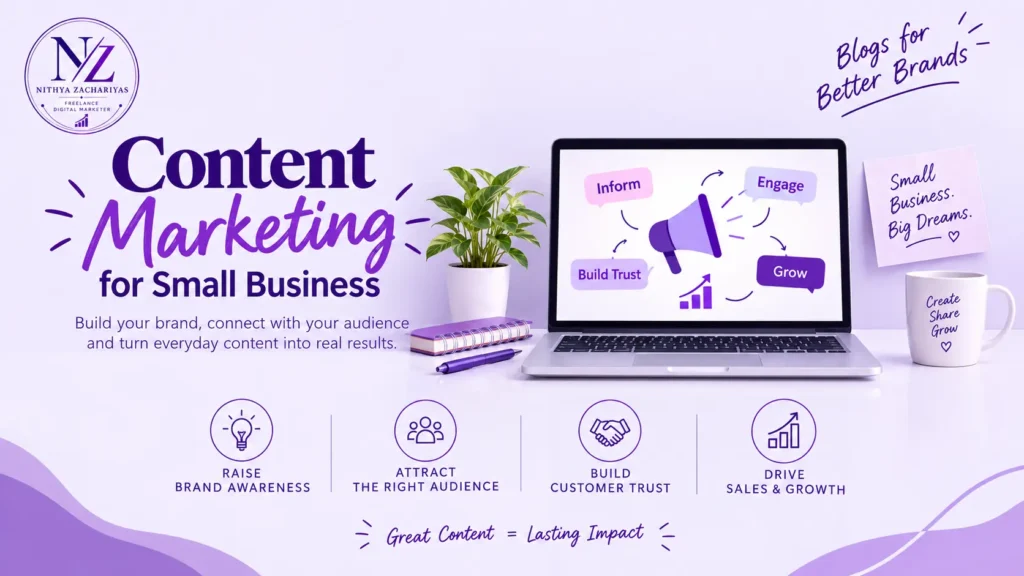
Content marketing for small business doesn’t require a large team or a big budget. Every week, I work with small businesses and startups who think that content marketing is reserved for big brands with in-house teams.Being a freelance digital marketer from Trivandrum, most of the small businesses and startups I work with assume that content marketing is accessible only to brands with big in-house teams. Actually, there are plenty of examples of small businesses who are consistent, focused, and strategic and have very limited resources who do some of the best content marketing.
This is a realistic, step-by-step program that creates content marketing for small business that works — on a budget.
1. At the start, set clear and simple objectives.
Before producing any content, though, determine what you really want it to do: obtain brand awareness, drive website traffic or leads. The only way content marketing for small business works is if every piece of content has some sort of goal attached to it. Otherwise you will just be posting randomly and get tired easily.
2. Before you know your content, you should know your audience.Before you know what to write, you should know who you will be writing it for.
3. Take the time to get to know your customer: their problems, questions and online hang out places. This is the simplest of the steps that can make or break your content and doesn’t require any extra investments.
4. Rather than choose ten Content Pillars, pick two to three.
Don’t attempt to write about everything, select two or three main points about which your business knows something. For instance, a bakery could have content on “behind the scenes baking”, “customer stories” and “simple recipe tips”. This speeds up the content creation process and helps to maintain brand recognition.
5. Create a basic content calendar.
There’s no need for complex software. If you just need to post a simple list, in a spreadsheet, of what, where and when, it will keep you consistent. Frequency is less important than consistency – twice a week does a lot more to the benefit of the reader than posting daily for 2 weeks and then disappearing.
6. Use One Content to Create Multiple Content Pieces
This is the largest content marketing cost-saving opportunity for small business. One blog post can evolve to become:
3-4 social media captions
A short video script
An email newsletter article
This is the Instagram Carousel.This is a feature of Instagram called the Instagram Carousel.
Expand ideas for multiple formats and platforms rather than develop new content each time
7. The use of free or low-cost tools.
No fancy software is required, as you can get started right away:
Mindfulness and other activities can be found in the free plan on Canva.
Using ChatGPT to generate ideas and initial drafts.Brainstorming and first drafts with ChatGPT.
Google Trends for topic ideas
Meta Business Suite for scheduling social posts
These alone will suffice for most small businesses’ initial requirements.
8. Presentation Skills
User generated content – reviews, testimonials, customer photos – is free, and is more trusted than pretty brand content. Ask customers to tag your business or post their review with your permission; then do the same.
9. Monitor what is and is not effective
Don’t require complicated dashboards for analytics. Just pay attention to what posts are performing best in terms of engagement, clicks or messages and do more of that. When decisions about content marketing are made based on actual results rather than educated guesswork, the small business’s marketing efforts are improving the quickest.
10. Patience is the key but consistency is required.
Content marketing doesn’t happen overnight. After 3-6 months of regular posting, most small businesses begin to make significant progress. Those who give up in month one are not going to receive the benefit of the results in month 4.
The Bigger Picture
Content marketing for small business isn’t about spending the same amount as big brands, it’s about being more consistent, more authentic and more accessible to your actual customers than big brands. Small businesses with their own direction and consistency can generally achieve better results than large brands with generic, mass-market content.
This is the type of content strategy I help small business owners in Trivandrum create — one that is achievable, sustainable, and one around what your company can afford to execute.